Student Visas · F-1
F-1 Student Visa: Documentation Help for New York Students
The F-1 visa is for full-time academic study at an SEVP-certified U.S. school, from universities to language programs. We help you organize your I-20, financial evidence and DS-160 so your file is consistent, and explain how to keep your status once you arrive.
Who the F-1 visa is for
The F-1 is the main U.S. student visa. It fits you if you have been admitted to a full-time program at a school certified by the Student and Exchange Visitor Program (SEVP), such as:
- A university or college (bachelor's, master's or doctoral programs)
- A community college
- An English-language program
- An academic high school, seminary or conservatory
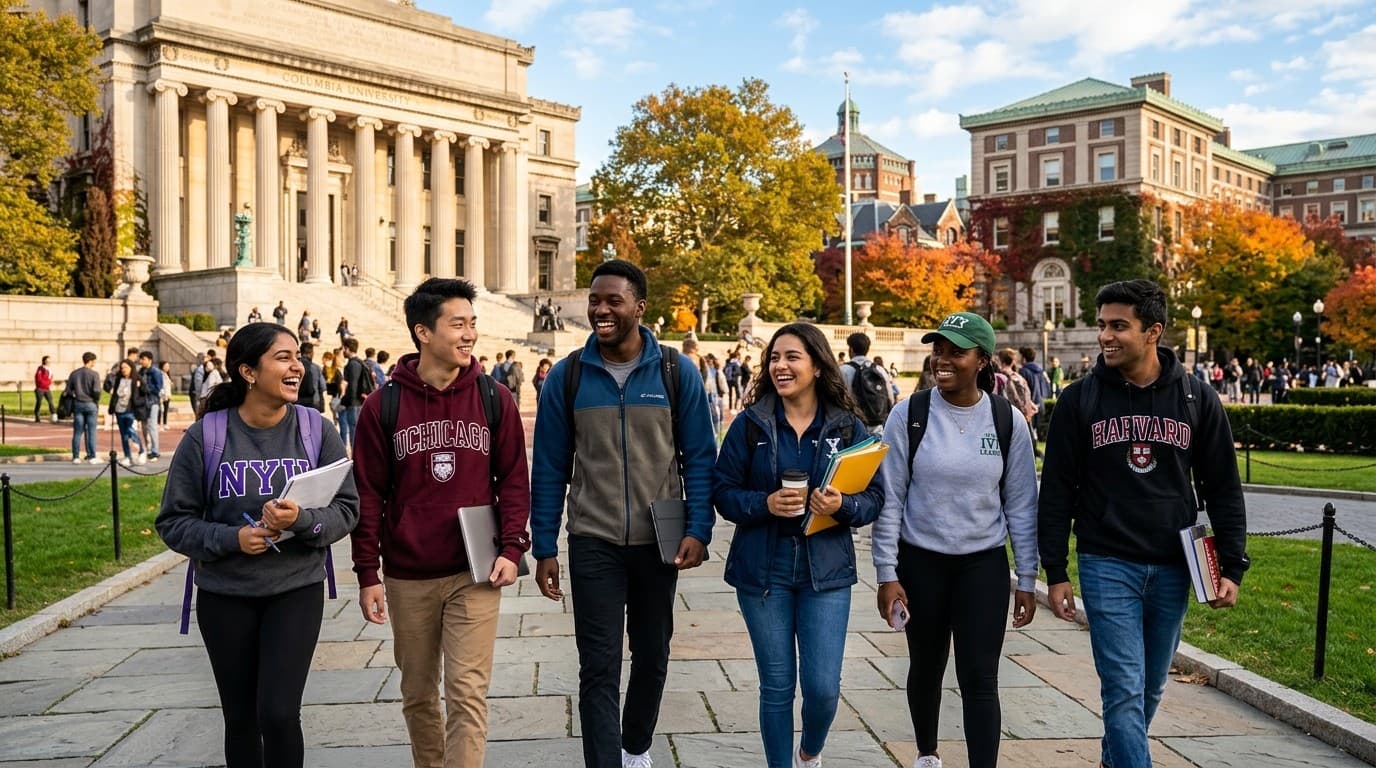
New York is one of the largest study destinations in the country, with CUNY and SUNY campuses, private universities across the five boroughs, and many language schools in Manhattan. Every one of these needs SEVP certification to issue an I-20. Confirm your school is certified before you pay a deposit.
If your program is vocational or technical rather than academic, the M-1 visa is the right category instead.
F-1 requirements at a glance
| Requirement | Details |
|---|---|
| Form I-20 | Issued by your school's Designated School Official (DSO) after admission |
| Full-time enrollment | You must keep a full course of study each academic term |
| Financial proof | Funds for at least the first year of tuition and living costs, as shown on the I-20 |
| SEVIS fee | $350 (Form I-901) for F applicants, paid before the interview |
| Intent to return | A residence abroad you don't intend to give up |
| English ability | As required by your program |
| DS-160 and interview | At a U.S. embassy or consulate abroad |
How NAIS helps with your F-1 documents
We prepare documentation; we are not a law firm. For F-1 students and families, we:
- Check that your I-20 details (name, program, dates, funding) match your passport and financial records
- Organize sponsor letters, bank statements, scholarship letters and loan documents into one clear funding picture
- Prepare or review your DS-160 so it lines up with the I-20
- Walk you through the SEVIS fee payment and keep the receipt in your file
- Prepare a short interview brief on your study plan, funding and plans after graduation
- For students already in the U.S., assemble change-of-status packets for USCIS
Every file is checked twice, and we quote a flat fee in writing. Government fees are separate.
Admitted to a New York school? Book a free 20-minute consultation and we'll build your F-1 checklist.
Book Free Consultation →F-1 process, step by step
- Get admitted to an SEVP-certified school and submit financial documents for your I-20.
- Receive the I-20 and check every detail.
- Pay the I-901 SEVIS fee online.
- Complete the DS-160 and pay the visa application fee.
- Schedule and attend your interview in your country of nationality or residence.
- Travel no more than 30 days before your program start date.
- Report to your DSO when you arrive so your SEVIS record is activated.
What's changed recently
- Duration of status rule blocked (Sept 14, 2026). DHS published a final rule on July 17, 2026 (91 FR 44976) to replace D/S with fixed admission periods of up to four years and cut the F-1 post-study departure period from 60 to 30 days. It was due to start September 15, 2026. On September 14, the U.S. District Court for the District of Massachusetts (Presidents' Alliance v. DHS) postponed it nationwide for F and J holders. The government filed an appeal on September 30, 2026. For now, D/S and the 60-day grace period continue. (Federal Register)
- Online presence review (June 2025). F, M and J applicants are asked to set social media profiles to public for visa screening. (State Dept.)
- Where you apply (Sept 2025). Applicants generally must interview in their country of nationality or residence. (State Dept.)
- Entry restrictions (Jan 1, 2026). Proclamation 10998 suspends F visas for nationals of certain countries. (Federal Register)
Life on the F-1 visa
Keeping F-1 status is mostly about routine:
- Stay enrolled full time, and talk to your DSO before dropping below a full course load.
- Keep your passport valid and your address updated with the school.
- Get a DSO travel signature on your I-20 before trips abroad.
- Work only on campus within the allowed limits unless you have CPT or OPT. See F-1 CPT / OPT Work Authorization for how those work.
- Transfers between schools and changes of program run through your DSO and SEVIS.
Your spouse and unmarried children under 21 can join you in F-2 status. After graduation, many students move to OPT and then to a work visa such as H-1B.
Related options
- F-1 CPT / OPT: work authorization during and after study.
- F-2 Dependent Visa: for your spouse and children.
- M-1 Vocational Student Visa: for non-academic training programs.
- J-1 Exchange Visitor Visa: for sponsored exchange programs.
- U.S. Student Visa Services: our full student hub.
Want your F-1 file checked before the interview? Book your free 20-minute consultation or call +1 (718) 973-9373.
Book Free Consultation →Frequently Asked Questions
At a U.S. embassy or consulate abroad, generally in your country of nationality or residence. There is no U.S. consulate in New York. Your school's location doesn't change where you apply.
ICE lists the I-901 SEVIS fee as $350 for F and M applicants. Pay it before your visa interview and allow at least three business days for it to be verified.
DHS published a rule to replace D/S with fixed admission periods, but a federal court in Massachusetts blocked it nationwide on September 14, 2026, one day before it was due to start. D/S continues while the case and an appeal proceed.
Initial F-1 students can generally be admitted up to 30 days before the program start date on the I-20.
Limited on-campus work is allowed. Off-campus work needs specific authorization such as CPT or OPT, which our F-1 CPT/OPT page explains.
In some cases, by filing with USCIS while your B-2 status is valid. You cannot begin full-time study until the change is approved, and leaving the U.S. while it's pending abandons the request.
Ready to Start Your F-1 Student Visa: Documentation Help for New York Students?
Schedule a consultation to discuss your case and find the fastest route forward.